MARSTEK VENUS E 3.0
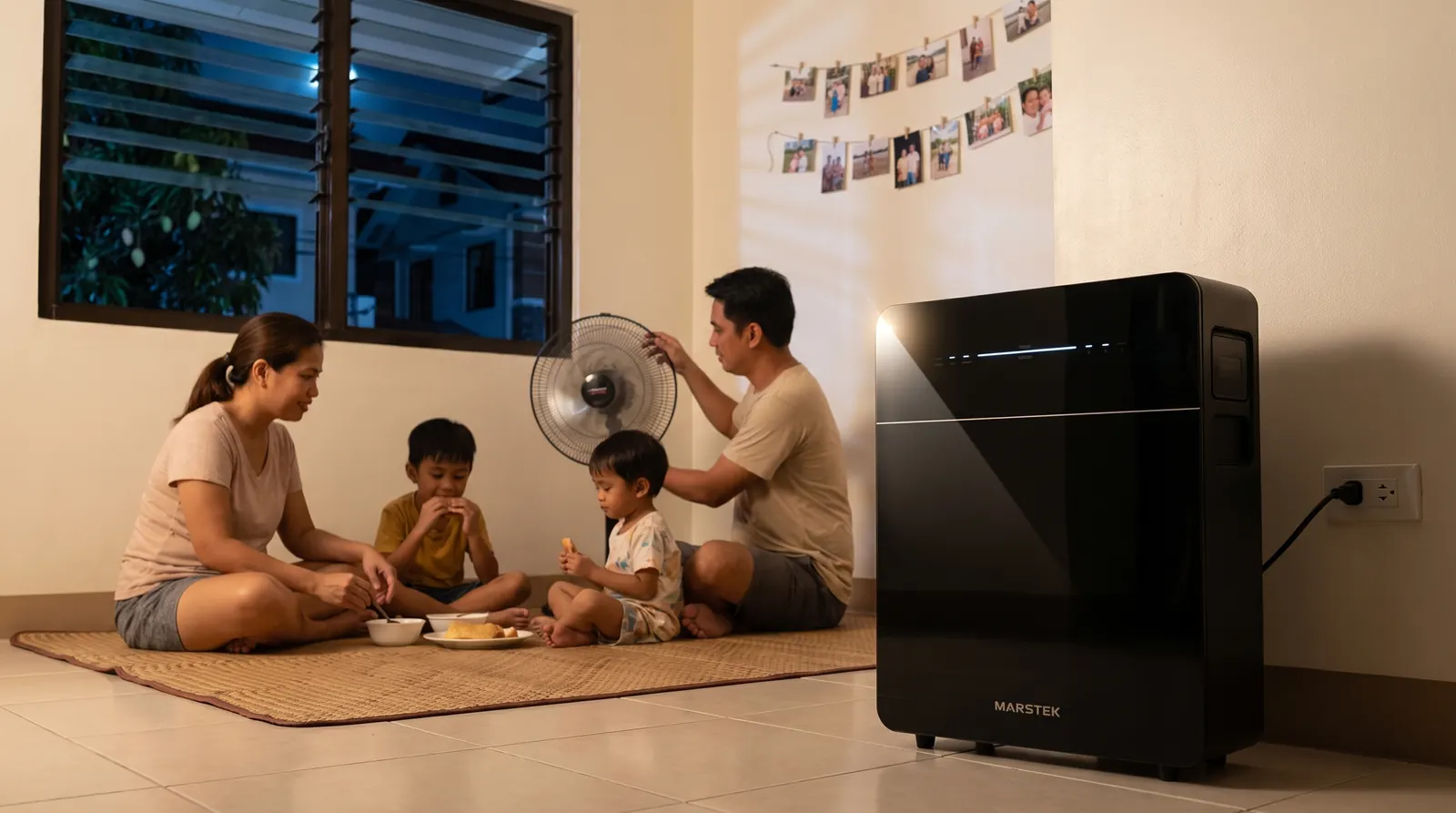
What it is: the VENUS E 3.0 (Philippine-edition model MST-BIE5-2500) is an AC-coupled energy storage system with a 5.12 kWh LiFePO4 battery. It plugs into a household socket (Grid port), charges from the grid or from surplus solar detected by a meter, and has its own BACKUP socket for essential loads during a brownout. Because it is AC-coupled, it works alongside an existing solar system of any brand, with no separate inverter needed for the battery.
Who it's for: homeowners who already have solar (or plan to add it) and want to store surplus energy, cut evening grid use, and keep essential loads running during brownouts.
Best for
- Homes with an existing solar system that want to store surplus solar instead of exporting it (Self-Consumption with a CT/meter).
- Brownout backup for essential loads (lights, Wi-Fi, fans, refrigerator) through the BACKUP socket, within the 2.5 kVA rating.
- Households that want app-based scheduling (Manual mode) or automatic optimisation (AI Optimization mode).
- Customers who need a plug-in battery rather than a full hybrid-inverter rebuild. If they are starting a new solar install from scratch, also compare the MARS I PLUS.
Key features
From the VENUS E 3.0 datasheet and the Philippine-edition manual:
- Three working modes (manual §1.6), configured in the MARSTEK app:
- Self-Consumption: requires a current transformer (CT). The unit discharges when the CT sees household load and charges when it sees solar being exported.
- AI Optimization: uses AI algorithms to build cost-effective charging strategies from consumption, solar generation and real-time electricity pricing.
- Manual: runs user-defined charge and discharge schedules.
- Compensation function (Self-Consumption + CT + Load): single-phase compensation, or three-phase total compensation that spreads output across phases A, B and C to keep net export close to zero. The manual "strongly advises" three-phase compensation for multi-device installations.
- Meter compatibility: fully compatible with MARSTEK CT002 and CT003 meters. Also compatible with Shelly Pro 3EM, Shelly EM Gen3, Shelly Pro EM-50, ECOTRACKER IR (Everhome) and PI Meter (HomeWizard). Each of these third-party meters supports only one device per phase.
- Whole-house backup: can work with the MARSTEK SmartBox for whole-home backup (manual §1.8). The datasheet describes a "SmartBox Backup Solution, Three-Phase Setup up to 7.5 kW Power and 15.36 kWh". See More products.
- External EMS: the system layout diagram shows RS485 / Wi-Fi / BT links to an external EMS.
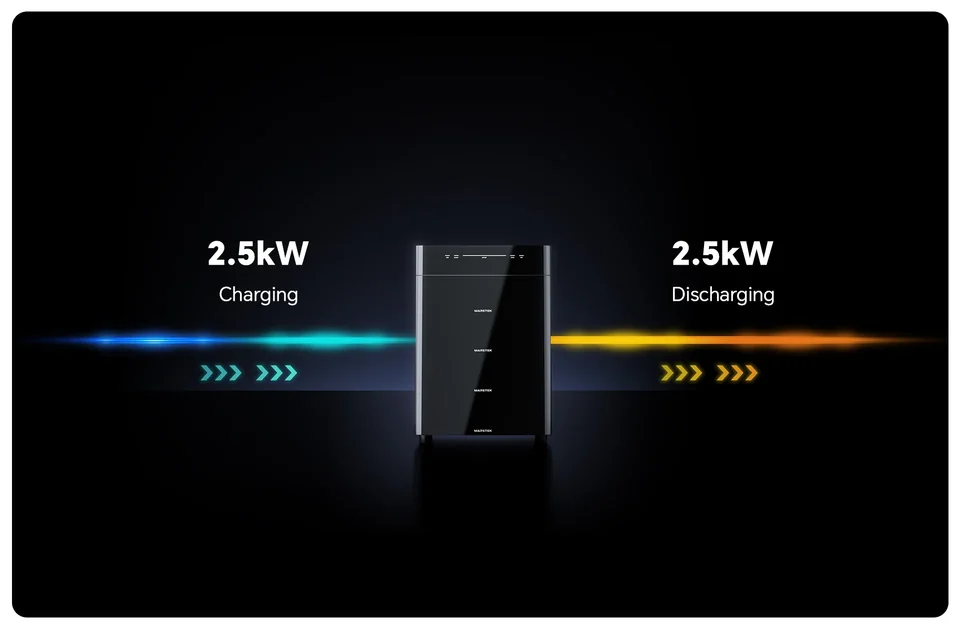
- LED indicators show error, Grid-socket on, BACKUP-socket on, capacity (flows left to right when charging, right to left when discharging), CT connected, Wi-Fi connected and Bluetooth connected.
- Natural cooling, IP65 enclosure, isolated design.
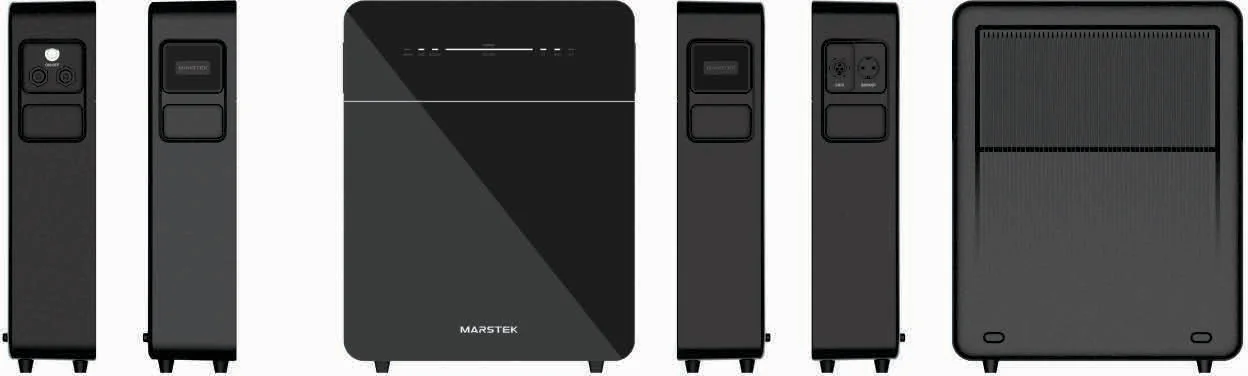
Product views
Specifications
The VENUS E 3.0 datasheet is written for 230 V / 50 Hz markets (grid range 187–253 V, 10.9 A, 60 ± 0.5 kg). The Philippine-edition manual (model MST-BIE5-2500) lists 220 V / 60 Hz, grid range 198–242 V, rated grid current 11.36 A and weight 55 ± 0.5 kg, and splits on-grid output into 0.8 kW default / 2.5 kW "Premium". The Philippine grid is 220 V / 60 Hz, so the PH-manual column is the one that applies to units sold here. Both columns are shown so you can explain any difference a customer sees online. Confirm the label on the actual unit.
| Specification | Datasheet (230 V / 50 Hz markets) | Philippine-edition manual (MST-BIE5-2500) |
|---|---|---|
| Battery | ||
| Rated voltage | 51.2 V (16S) | 51.2 V |
| Capacity / battery energy | 5.12 kWh | 5,120 Wh (100 Ah) |
| Cycle life | >6,000 (25 °C) | >6,000 (25 °C) |
| Cell type | LiFePO4 | LiFePO4 |
| Depth of discharge (DoD) | 90% | 90% |
| AC input (charging from grid) | ||
| Rated input power | 2.5 kVA | 2.5 kW |
| Working phase / grid connection | L/N/PE | L/N/PE |
| Rated grid voltage / frequency | 230 V / 50 Hz | 220 V / 60 Hz |
| Grid voltage range | 187–253 V | 198–242 V |
| Rated grid current | 10.9 A (listed as "rated grid output current") | 11.36 A |
| Power factor | >0.99 (default), 0.8 lagging … 0.8 leading (adjustable) | >0.99 (default) / 0.8 leading ~ 0.8 lagging (adjustable) |
| THDi | <3% | <3% |
| AC output, on-grid | ||
| Rated output power | 800 VA / 2.5 kVA | 0.8 kW (default) / 2.5 kW (Premium*) |
| Rated grid current (output) | 10.9 A | 3.48 A (default) / 10.9 A (Premium*) |
| Backup (off-grid) | ||
| Rated output power | 2.5 kVA | 2.5 kVA |
| Peak output power | 3.5 kVA (10 s) | 3.5 kVA, 10 s |
| Rated output voltage | 230 V / 50 Hz | 220 V / 60 Hz |
| Rated output current | 10.9 A | 11.36 A |
| THDu (linear load) | <3% | <3% |
| Efficiency | ||
| Battery side to AC side, maximum | >93.5% | >93.5% |
| Protection | ||
| Protection class | I | (value not legible in manual text) |
| Overvoltage withstand level | DC II / AC III | (value not legible in manual text) |
| General | ||
| Isolation type | Isolated | Isolated |
| Ambient temperature range | -20 °C to 55 °C (storage -30 °C to 85 °C) | (value not legible in manual text) |
| Relative humidity | 0–95% | 0–95% |
| IP rating | IP65 | IP65 |
| Cooling | Natural cooling | Natural convection |
| Max. operating altitude | 2,000 m | 2,000 m |
| Dimensions | 480 × 153 × 624 mm | 480 × 153 × 624 mm (L × W × H) |
| Weight | 60 ± 0.5 kg | 55 ± 0.5 kg |
| Additional data | ||
| AC grid connection | 3-wire plug (Euro 16 A) | Three-wire household plug (Euro 16 A) |
| Off-grid socket | 3-hole socket (Euro socket) | — |
| Display | LED | LED |
| Communication | Wi-Fi, Bluetooth, Ethernet, RS-485 | Wi-Fi & RS-485 (waterproof aviation plug) |
| Grid-connection standards | NF-EN 50549-1, VDE 4105 / VDE 0124, G98, CEI 0-21, PETREE, PN-EN 50549-1/-2, TOR R25, UNE217001/217002, NTS631, AS 4777.2 | EN 50549-1 |
| Regulatory & EMC | IEC 62040, IEC 62477, IEC/EN 61000-6-1/2/3/4, IEC/EN 61000-3-2/3, EN 300 328, EN 301 489-1/17, EN 50665, CB 62619 | EMC: IEC/EN 61000-6-1/-2/-3/-4 |
*Manual note: "Enabling this function must comply with local regulations and should only be performed by authorized personnel!" The manual also notes that the rated voltage/frequency range can be changed according to the requirements of the local power department, and that local electrical regulations decide how many VENUS units may be connected to each branch circuit.
Sources for this table: datasheet column transcribed from the VENUS E 3.0 datasheet spec page (checked against the rendered image); PH column from the Philippine-edition VENUS-E user manual (MST-BIE5-2500), §5 Technical Specifications.
The Philippine-edition spec table lists only "WIFI & RS-485". The same manual's interface section shows an RS485 socket, a LAN (wired network) port, and LED indicators for Wi-Fi and Bluetooth, and its layout diagram shows "RS485/Wifi/BT". Treat Wi-Fi, Bluetooth, LAN and RS-485 as present, but confirm on the unit before promising a specific integration.
Interface (Philippine-edition manual §1.4)
| Label | Function |
|---|---|
| A, RS485 | RS-485 protocol communication socket |
| B, On/Off button | Press to turn on / turn off |
| C, LAN | Wired network connection port |
| D, Grid | Connects the system to the household grid |
| E, BACKUP | AC socket for powering loads during outages |
Price (SRP)
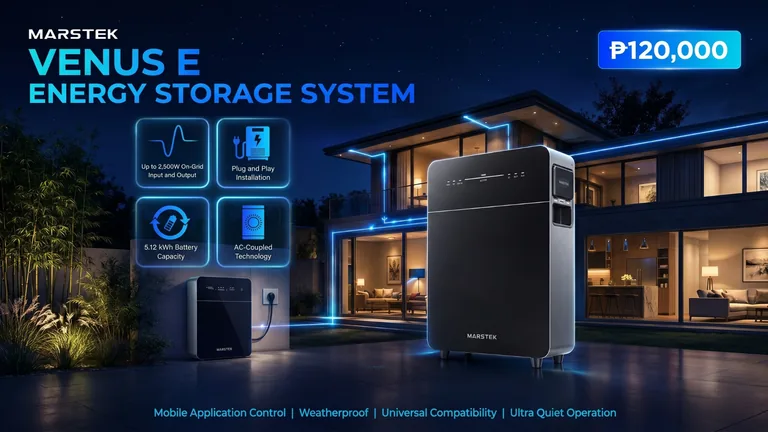
Per the SRP flyer in Drive, the VENUS E is ₱120,000 (original price ₱179,000). The flyer says "VENUS E" without a version number. Confirm current pricing with Silvera Solar Power before quoting. See the full price list.
Installation & safety
These rules come from the Philippine-edition manual (§2, §4 and §6).
Do not connect both the Grid and BACKUP sockets to the city power network. The manual warns this will cause a circuit break or device damage, and that improper wiring can cause short circuits, system failures from current backflow, and fire hazards.
- Who installs: only qualified professionals or properly trained personnel may install, operate or maintain the equipment. Do not power it on until it has been correctly installed or confirmed by a professional. Maintenance is for authorised personnel only.
- Utility approval: approval from the local utility company must be obtained before operating in grid-tied mode. The 2.5 kW "Premium" on-grid setting must comply with local regulations and be enabled only by authorised personnel.
- Orientation: install upright only. Never tilt it forward, backward or sideways, and never lay it horizontally or upside down.
- Mounting surface: preferred surfaces are solid brick-concrete structures, concrete walls or floors. Other materials (e.g. drywall, wood) must be as flame-retardant as possible and meet the load-bearing requirement. Otherwise, ensure there are no flammable or explosive items in the environment.
- Clearance: keep clearance around the unit for heat dissipation and safety isolation. Do not place other equipment nearby (except VENUS-compatible devices and approved awnings) or any flammable or explosive materials.
- Environment: dry, well-ventilated area, away from liquids. Do not block ventilation. Never in flammable or explosive gas or smoke.
- Circuit breakers: each branch line must have a circuit breaker; a central protective device is not necessary.
- Accessories in the box: AC cable ×1, unit-side mounting bracket ×1, wall-side mounting bracket ×1. Wall mounting (steps 1–2) is optional.
- Recommended tools: screwdrivers, wrench, diagonal pliers, insulating gloves, measuring tape.
- Wiring (step 4): connect the cylinder end of the supplied AC cable to the VENUS Grid port and the plug end to the household socket. Plug the home-load wiring into the BACKUP socket.
- Maintenance: inspect at least once a year and keep heat-dissipation parts unblocked. Unplug from the grid before maintenance unless otherwise specified. The AC output harness must not be replaced: if it is damaged, the whole device must be scrapped. Users must not repair internal parts.
- Personal safety: power off before installing; do not connect or disconnect cables while live; remove watches, rings and similar items; use insulated tools; the surface may be hot.
Related tutorials
- VENUS E 3.0 installation
- VENUS E app & working modes
- Brownout preparedness
- VENUS E troubleshooting & error codes
- Backup calculator
- Accessory: CT002 Smart Meter
Sources
- VENUS E 3.0 datasheet (Drive): datasheet column, features, product views, hero image
- VENUS E 3.0 user manual, Philippine edition MST-BIE5-2500 (Drive): PH column, modes, meter compatibility, installation & safety
- MARSTEK Flyers – SRP (Drive): price
- MARSTEK Brand Kit (Drive): 2.5 kW graphic